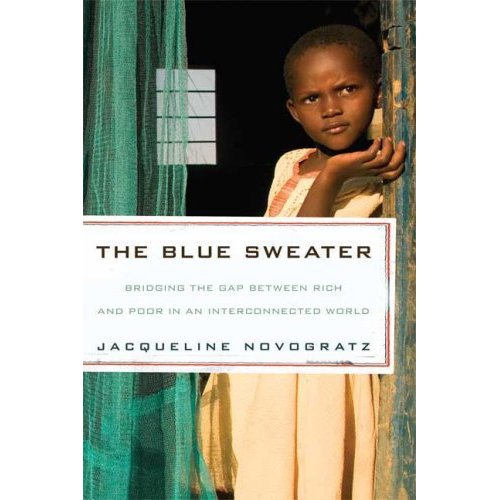
Wow, I can’t believe it’s been a year since I wrote a comprehensive summary (is it grammatically incorrect to put those two words next to each other? ) of the books I’ve read. I’ve mainly been avoiding this because I wanted to do a grandiose post on what I thought of each book, with quotes, summaries, deep thoughts, etc. I’m realizing that might never happen, so something is better than nothing.
Of the three books I was reading when I last wrote something on this topic, I’ve finished two of the three. I still haven’t finished reading the White Man’s Burden…I don’t think I’ve even touched it since my last post about it. Oh well, I guess that one will stay on the shelf another year or so.

So, without further ado, here we go.
In Defense of Food: An Eater’s Manifesto, by Michael Pollan
I absolutely loved this book. “Eat food. Not too much. Mostly plants.” This is the main motto, which sounds a lot simpler than it really is. For example, a lot of the “food” that you eat isn’t really food, it’s highly processed stuff. So when he say’s “eat food,” there’s a much more significant meaning to what he’s saying than you might think (“But I contend that most of what we’re consuming today is no longer, strictly speaking, food at all, and how we’re consuming it–in the car, in front of the TV, and, increasingly, along–is not really eating, at least not in the sense that civilization has long understood the term.”). I think this is a great introductory book to changing eating habits, and how you see the food industry in general. There are some crazy statistics that really make you think about what you’re eating, and why you’re eating it (think: congressional lobbies). I’ve been wanting to read some more books on this topic since I finished this book, but just haven’t gotten around to it. One of the cleverest suggestions from this book: shop in the periphery of the grocery store: it contains the freshest and least processed stuff (produce, veggies, etc., versus boxed meals). Some of my favorite quotes:
- “Thirty years of nutritional advice have left us fatter, sicker, and more poorly nourished.”
- “…the processing of foods typically robs them of nutrients, vitamins especially.”
- “By breaking the links among local soils, local foods, and local peoples, the industrial food system disrupted the circular flow of nutrients through the food chain.”
- “Foods that lie to our senses are one of the most challenging features of the Western diet.”
- “…and Americans are consuming a diet that is at least half sugars in one form or another–calories providing virtually nothing but energy.”
- “It’s hard to believe that we’re getting everything we need from a diet consisting largely of processed corn, soybeans, rice, and wheat.”
- MY FAVORITE: “[y]ou now have to eat three apples to get the same amount of iron as you would have gotten from a single 1940 apple, and you’d have to eat several more slices of bread to get your recommended daily allowance of zinc than you would have a century ago.” INSANE (emphasis added).

Jim (co-founder of Haiti Scholarships) sent me this book out of the blue. I actually was a little concerned about who had sent the book to me, since I had no idea where it came from, and someone clearly had my address, and new of my interest in Haiti, haha. But all was well, and no one was stalking me.
This is a really short and quick read, but very inspiring story–which, I’m sure, is why Jim sent it to me. It tells the real st
ory of one woman’s journey to Haiti, and how she started an organization to help feed children in Haiti. It was great reading about someone going through a similar struggle with getting an organization started and off the ground, and seeing it succeed. I hope Haiti Scholarships grows to have the same success that her organization has. Some of my favorite quotes:
- “It took Haiti 125 years to pay off the debt to France (estimated at a value of $21 billion today with interest and inflation calculated in), and the effects on the society were devastating.”
- “Iwas relieved to be back in the States, where the comforts and convenience and abundance overflowed. But at the same time, I felt nauseated.” A feeling that’s easily relatable for those who have traveled to similar places, I’m sure.
- “Normally, I planned out every detail of a business trip, complete with a typed agenda neatly placed in a folder.” I was just relieved to see that someone else does this.
- A topic Reuben and I have frequently discussed is religion, and how religion seems to be more abundant in poorer areas: “‘God is the first and last resource here. We feel God’s presence more and more, because there is nobody else some days who can sustain us to allow us to survive. It’s only God sometimes…Because the neighbor doesn’t have enough, the friend’s don’t have anything, so we’re praising God. God makes miracles. So we live by miracles, and as we live by miracles, we need faith. Our faith sustains us.'”
- “This led to the importing of heavily subsidized U.S. rice, which was cheaper than Haitian rice. After a few years, Haiti’s peasant farmers could not compete and most went out of business.”
- “Haiti is thethird-largest importer of rice from the U.S.–240,000 metric tons per year. Until the 1980s, Haiti was self-sufficient in rice production.” Crazystatistic.
- “Or maybe because I was discovering more and more how unfair the world is, how cruel it can be. The disparity between my life and the lives of everybody I met in Tiplas Kazo weighed on me all the time.”
Organization that’s Winning the Fight Against Poverty, by Ian Smillie

This book was given to me by Reuben, and it’s
another inspiring story about a nonprofit who grew quickly to address some pressing issues around the world (and curiously enough, the nonprofit that a good friend of mine went to work for in Haiti shortly after I finished reading this book!).
The title itself gives you a synopsis about what the book is about. BRAC is similar to Acumen Fund, which I mentioned on my summary of The Blue Sweater, both organizations focus on microcredit a
s a way to relieve poverty. I think one of the things I liked best about this book is that it was honest about what worked and what didn’t work for the organization when it was first starting. It’s great to know that organizations don’t always get things right, but the difference is in manning up to that, and making it better. I’m gonna post some of my favorite parts, but this book is chalk full of great follow up resources, from other books, to articles, to organizations, etc. (I still have to follow up on all of these highlights, of course).
- “[D]eveloping countries are littered with failed income-generation projects that have generated little more than loss and disappointment. While there has never been a lack of bright ideas and good intentions among aid agencies, there has too often been a surfeit of amateurism that, combined with money, can be deadly.”
- “It is a sad commentary on countries in Europe and North America that provide foreign aid with one hand–dispensed with lashings of advice about how poor countries must liberalize their economies and eschew subsidies–while simultaneously undercutting the world price of grain, dairy products,and other goods through generous subsidies to their own producers.”
- “Generally, increasing the average amount of education in the labor force by one year raises GDP by 9 percent, a statistic that holds for the first three years of education.”
- “‘The role of education in reducing absolute poverty is decisive. Many research studies…[have] concluded that rising levels of education in a society were often accompanied by a sharp decline in absolute poverty. When poverty levels were correlated with such variables as mean years of schooling, adult literacy, and gross enrollment rates, it was clearly established that absolute poverty declines as education increases.'”
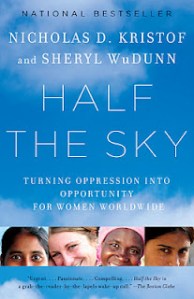
Half the Sky: Turning Oppression into Opportunity for Women Worldwide, by Nicholas D. Kristoff and Sheryl WuDunn
I read this book on the plan to and from Haiti. It’s a hugely successful book, with a movie in the works, as well as an organization of the same name that exists to combat all the ills against women that this book talks about.
The stories in this book, from real women around the world, are sad, and compelling. It’s crazy to think that in our day and age, this things are still happening to women…to people.
Similar to Freedom from Want, this book is full of great resources that I have yet to follow up on.
- “‘More weight is still given to the crime of stealing a thing than to the crime of stealing a person.'”
- “…21% of Ghanian woman reported…that their sexual initiation was by rape; 17% of Nigerian women said that they had endured rape or attempted rape by the age of nineteen; and 21% of South African women reported that they had been raped by the age of fifteen.”
- “The United Nations Population Fund has estimated that there are 5,000 honor killings a year…”
- “‘It has probably become more dangerous to be a woman than a soldier in an armed conflict.'”
- “In just the Congolese province of South Kivu, the UN estimates that there were twenty-seven thousand (27,000) sexual assaults in 2006.”
- “One of the great failings of the American education system, in our view, is that young people can graduate from university without any understanding of poverty at home or abroad.”
- “The equivalent of five jumbo jets’ worth of women die in labor each day, but the issue is almost never covered…Some 99 percent of those deaths occur in poor countries.”
- “The World Bank estimated that for every one thousand girls who get one additional year of education, two fewer women will die in childbirth.”
- “‘Women are not dying because of untreatable diseases. They are dying because societies have yet to make the decision that their lives are worth saving.‘”
- “Another study suggested that it would cost an additional $9 billion a year to provide all effective interventions for maternal and newborn health to 95% of the world’s population…Suppose that the estimate of $9 billion per year is correct. It pales beside the $40 billion that the world spends annually on pet food…”
- “To deny women is to deprive a country of labor and talent, but–even worse– to undermine the drive to achievement of boys and men.”
- “If we believe firmly in certain values, such as the equality of all human beings regardless of color or gender, then we should not be afraid to stand up for them; it would be feckless to defer to slavery, torture, foot-binding, honor killings, or genital cutting just because we believe in respecting other faiths or cultures.”
Poor Economics: A Radical Rethinking of the Way to Fight Global Poverty, by Abhijit V. Banerjee & Esther Duflo

I think this was the first book we read for our book club. Not as difficult for me to follow as The White Man’s Burden, but it’s up there. This book tackles many difficulties in getting people out of the “poverty trap,” including global health, education, economics, etc. My favorite parts of this book were the parts that made me look at situations through a different lens. Why don’t poor people save? Why don’t they get medical insurance for when they get really sick? Why don’t they go to a doctor instead of a local? Why do they have so many kids? Why don’t they realize the value of an education?
I’m not gonna lie, I’m pooped. So if you’re interested, I’ll have to owe you my favorite quotes from this book.








 Finca Cielo Azul