I read this article today, and it really upset me. So I wanted to share it.
Discussions on Development: The Right of Indigenous Communities to Hit the Airwaves
27 Friday Jan 2012
Posted in Castresana, CICIG, corruption, Guatemala, impunity, news
27 Friday Jan 2012
Posted in Castresana, CICIG, corruption, Guatemala, impunity, news
I read this article today, and it really upset me. So I wanted to share it.
16 Monday Jan 2012
I’ve written and translated before regarding the case of Cristina Siekavizza. Today I came across another piece that I felt compelled to translate and share with everyone. I’d like this to be a companion piece to a future blog entry on violence against women in Latin American countries.
23 Friday Sep 2011
Posted in charity, Charity of the Month, Guatemala
They decided to adopt. Then they decided to adopt from Guatemala. Then someone else decided they should actually go to Guatemala before they adopted a child from there: “You have to find ways to give back to a country that is going to be giving you the gift of a child.” It’s funny, isn’t it, how a simple nudge from someone else can completely change your life. Bill and Cherie did just that, and in 2004 they traveled to Guatemala, where they met Tita two nights before their flight back to the U.S. They had already spent eight days meeting people, places, and things. But they hadn’t met Tita yet, or La Limonada, or their future.
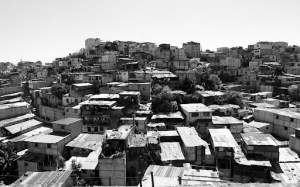
Tita turned out to be their inspiration: a woman who for five years had been singlehandedly working in one of the most dangerous and largest urban slums in Guatemala: providing care, comfort and food to the most vulnerable of the vulnerable. La Limonada is basically a settlement in a ravine, considered a Red Zone area because of how dangerous it is, and home to about 60,000-100,000 people. These people live in one of 10 different districts, each of which are ruled by rival gangs and invisible but life-threatening boundary lines.
What did Tita show Bill and Cherie on their last day in Guatemala? She showed them the shanties where families lived huddled together, she showed them families that dulled their hunger pain by sniffing glue, she told them about the sexual abuse that runs rampant in La Limonada, she told them about the gang violence and warfare that had her attending at least one funeral a week. But she also showed them the school she had started, she showed them the children she looked after, she told them about her plans for the future: how she wanted to be able to teach more kids, she wanted to reach out to gang members and show them a different way of life, she told them about wanting to start a vocational center for those gang members, she told them about wanting to send kids to school.
Seeing and hearing these stories changed their lives. As much heart and as many plans as Tita had at the time, she was overwhelmed by the amount of work and money that it took to do everything she was doing or wanted to do. Bill and Cherie saw the need and opportunity to step in and help, and they did. And you know what? They’ve pretty much made all of Tita’s plans a reality.
Bill and Cherie founded Lemonade International and started raising money for Tita and La Limonada, and Bill allowed me to ask him some questions about how all of this came about. Here’s what happened since they founded Lemonade International, as a volunteer side project:
This is all just the beginning stages! Bill talked about their plans to buy a building that will house the vocational training program. The program is still in the initial stages, and often they don’t have the room or a safe location to consistently have their classes in. They are currently looking at a building that is located in between the two schools, they just have the difficult task of raising the funds to purchase it. Ideally, this building will house training classes for sewing, carpentry, masonry, electrician training, etc.
Of course, these accomplishments and goals for the future are no easy feat to come by: Lemonade International is working in a country with difficult and straining conditions, among a dangerous population, and with the mentality of wanting to establish something that is not dependent on U.S. donors, but self-sustaining.
Sustainability. I love that word. One of the goals for the vocational center is that it will create businesses, like bakeries and carpentry shops, that will help maintain some of the other programs. The are trying to get this sustainability started by looking for a local Community Development Director: someone who will oversee all the programs in Guatemala, and to focus on the sustainability and long term plans of current projects.
This brought us to something else Bill thinks is important for the future of Lemonade International: engaging local people in Guatemala to support the work of La Limonada, to inspire them to care about their own country. We had an interesting conversation about classism in Guatemala: there is still a great divide between people of different socio-economic levels, not to mention indigenous mayans vs. ladino’s. It would be great if instead of having people from the U.S. going to Guatemala to lead these programs, you have Guatemalan’s caring about each other across these socio-economic divides, and leading these programs.
Bill recognizes that something like this will take time, and is steering clear of setting himself up for an “unrealistic disappointment.” He knows sustainability is something that will take time, and until then, raising support in the U.S. to help kids go to school, which may not be sustainable, is better than doing nothing.
Through it all, what keeps Bill and those around him going is seeing the smiles on children’s faces, smiles that weren’t there years before, children that walk with their heads held a little higher than they used to. What else keeps Bill going? His vision for the future of La Limonada:
I want to stand on the bridge overlooking La Limonada, and see people walking around confident in themselves and knowing their self worth, see people who know they can achieve things, that they are part of a community where good things are happening, a community with art, and music. I want to see houses painted with bright Guatemalan colors, and flower boxes hanging under windows. I want to see the hustle and bustle of business: tortillas being delivered, schools in session, festivals and parades. All of this, with no concern for violence.

22 Thursday Sep 2011
I apologize if my repeated posts about this woman are boring or uninteresting to some, but I truly believe that her story is worth writing about, or in my case, translating about. I think this case has brought Guatemala to a crossroad, and there are some exceptional women in that country who are trying to make sure they make the right turn, by not keeping silent. There are a couple blogs from the original writer who brought us this story that I have been wanting to translate, but they take more time in skill due to her exceptional writing, so they will come with time. But today, I came across the following opinion piece, and felt is was worth translating and sharing. The subject is something that I’ve wanted to blog about for over a year, and I just haven’t made the time to do so: why are women in our culture (by “our” I mean Hispanic) so frequently victims of domestic violence? And why do they remain in relationships marred by domestic violence? As a volunteer with several legal nonprofits, I have worked with women who were victims of domestic violence in order to help them apply for immigration relief (through VAWA and U-Visa petitions), and the degree and frequency of violence that so many of these women put up with has always scared me. Alas, I should save my “opinion” piece for my own blog entry…
The Robert Barreda Syndrome
(As published on September 22, 2011, in El Periodico)
In Guatemala, things have to change and the aggressors have to know that their only place is in jail.
Sylvia Gereda Valenzuela
Since 2001 I have worked and investigated the subject of femicide and aggression against women in Guatemala. I find it interesting that we have such an aggressive male population, that has caused more than 6 thousand women to die in the most cruel ways: tortured, severed in their private parts, raped, and mutilated.
In those days, Ciudad Juarez was a site of murders that moved the world. Ten years later, Guatemala left Mexico behind.
I got to know the case of Mindi Rodas, the woman who’s husband ripped off her face, nose and mouth with a knife and after a long battle for justice was murdered.
I got to know the case of Claudina Vasquez, a young woman who was going to be an attorney, that was first raped and then put on her knees to die with a bullet to the temple.
Towards the middle of this decade, while I was going through my masters in sociology, I completed a thesis about femicides in Guatemala, and then I had to course through the morgues, see puddles of blood that wet my shoes, the bodies of dozens of women that arrived cut in pieces and their faces bruised. That year, when I started my television project of Informe Especial (Special Report) on Canal Antigua, I decided to go back and check the pulse of this silent drama. I didn’t even have to take a step to realize that the problem had surpassed us.
In July I started to investigate the disappearance and murder of Cristina Siekavizza, where the principal suspect is her husband Roberto Barreda. A story already known by everyone, but where the aggregate of influence peddling, abuse of power by Barreda’s parents, Beatriz De Leon and Roberto Barreda, has been an important factor in keeping this case without any punishment and allowing the two minors to disappear along with their psychopath father, according to those who have declared to know the case: the judge Veronica Galicia and Norma Cruz.
I have found myself with more than three dozen messages and letters from women commenting that the story of Cristina has made them understand the dangerous drama in which they are submerged. Many, for the first time, seeing the criminal extremes that Barreda allegedly reached, are daring to break the cycle of violence and raise their voice.
“My sister that was married for 33 years with a psychopath, controlling and feticidal that followed her with a gun, hit her, etcetera. Today she has separated from him and she is getting fucked over. He left her in the street, even though he has millions in accounts in the United States and he uses his best friend as a figurehead. She gave him her whole life, since she was 19, she never finished her career nor did she ever work. He told her that he was never going to giver her anything, over his dead body.”
“He would get home late, drunk, aggressive, he would smack me around.”
“He left with some girl that was 20 years younger than him, got her pregnant. When I confronted him about it he grabbed me and hit me, he slapped me and insulted me.”
“I knew that he lived in bars and whore houses. On three opportunities he transmitted venereal diseases to me. He would threaten me that if I left him he would leave me in the street and ruin me forever, I have never worked.”
Norma Cruz, president of the Fundacion Sobrevivientes (Survivors Foundation), told me on one occasion that Guatemalan woman has started to talk about what she called the “Barreda Syndome,” many of the attacked women are seeing in Roberto Barreda, a man that appeared to not be aggressive but that was a despot at home, their own husbands. En the case of Barreda, nobody saw the alleged murderer of his spouse coming. But when everyone reacted, Cristina had ceased to exist and her children had disappeared.
I have always believed that we all came into this world with a mission, that no life is in vain, just like no death is in vain. Cristina has moved more hearts and sentiments with her death than she did with her life, this is a sign that her spirit continues still today and it can be the point of inspiration so that many women who have been attacked start to talk and ask for help from prosecutors, support groups, or organizations in defense of women.
For my part, these stories of terror that have hit so many guatemalan women hurt me to my core, and they motivate me to commit myself with what I will soon start as a new life project, to save thousands of women, teenagers, and girls who are victims of violence. If I can be sure of something, it’s that today, more than ever, I will not lower my voice and I ask the women that they don’t either. In Guatemala, things have to change, and the aggressors have to know that their only place is in jail.
18 Sunday Sep 2011
Posted in corruption, Cristina, Guatemala
I translated a blog from a friend in Guatemala back in July, it was her battle cry for justice in a country that seems to spin further and further out of control. That specific blog was prompted by the disappearance of an old classmate’s sister: a wife and mother of two children. Since her disappearance, classmate’s have banded together, and have refused to let Cristina be forgotten as just another disappearance, or simply another statistic. Since her disappearance, events have continued to unfold, and evidence indicates that the night before her disappearance, her and her husband got into a serious argument, after which she ran out to the balcony of her home and screamed for help. No one did anything. Although her body has not been found, it seems the husband used the family car to dispose of her body, and disappeared with the children days later.

12 Tuesday Jul 2011
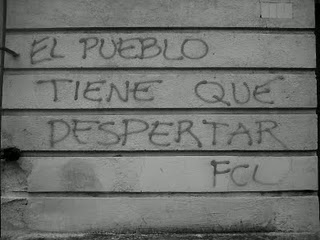
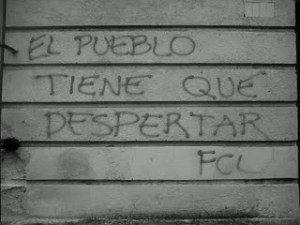
The wall is blue and the spray paint black. The blue wall belongs to one of those houses easily recognized in the Historical Center of the city of Guatemala. An old house, doomed to be forgotten, to the wearing down of the paint, to the fetid smells that can scare away the curious that for any reason wanted to know its story. I saw it three weeks ago and it wasn’t until today that I took a picture of that phrase that frames the entrance. The phrase doesn’t talk about past loves or threats, it doesn’t talk about political propaganda and it also doesn’t talk about messages between the gangs. Some passerby, one of those adventurous ones that walks on foot and with a backpack probably wanted to launch battle cry. One of those cries that we Guatemalans have stuck in our throat, a magnificent replica of those that we cry at the moment of birth, maybe because we know ourselves to be Guatemalan.
We know ourselves Guatemalan and even though every person cries at birth, independently of the place of birth, I’m sure that we understand from the maternal womb that living here is not easy, we understood that the books of our history cry blood. The majority of us know that at some moment in life we will also have to grab a weapon at any cost and with such weapon, a cry to war. I don’t mean those weapons devoted to lead and smelling of gunpowder. We cry because we have more sophisticated weapons: those that exude blue ink, black or green (such as Neruda’s admirers), we cry because our weapon is our voice, our drawings or perhaps our guitar. We cry because we know that we’ll have to take them up and we will be persecuted. Better that way, we’ll know we’ve done things right.
There are some illiterate, others like myself that aren’t good for anything beyond making a sketch that can be confused for a tree, but the truth is that each of us have a weapon, that can be your smile, your hope, your own integrity, your punctuality at work, your constancy for investigating, your eagerness to shine your clients shoes well, or who knows, to make him happy.
My uncle Epaminondas, inexhaustible fountain of my daily inspiration, stressed that it’s possible to be the best in what you do without losing the path of what is right. He achieved it. I dare someone to refute that. If he did it, why not you? Why not me? If being one of the good guys is difficult because it brings along with it beautiful sleepy nights and a smile on the recumbent body. That smile that indicates that death has been cheated to enter into immortality. That’s how the good ones are, immortal…and in many instances, anonymous.
Why do we Guatemalans cry? What intuition did we have at birth? If we know ourselves loved by greats, we know ourselves owners of an exquisite millennial history, we know ourselves owners of a luxurious gastronomy, owners of a great part of the color green in America, owners of colors.
We cry at birth because we know that we have to share this land with those who did not deserve to even see the blue of our flag, we cry because we know that not everyone who leaves their house today will come back and maybe we ask ourselves if he or she had an opportunity to say goodbye in their own way and to feel loved in the middle of a country that has cancer, of a country that seems to hate. We cry because a lot of us have family members who have been killed for political motives, because we have family members who have been kidnapped, because we have had threats of death even over our heads, because even without opening our eyes we have read the history and its only ten years of glory. We cry and starting there we are revolutionaries, starting there we have in our throat and in our chest the battle cry.
We cry because we are part of that rare race, of survivors.
And who said crying was bad? If it revitalizes, if it gives peace…we cry at birth because we feel like it, because that’s how we Guatemalans like to be. And afterwards we draw a smile, we adjust our backpack, and we go ahead, as if nothing had happened. And we smile and on the inside we cry because it seems like we live in a permanent state of mourning. That’s how the history is, that’s how Hemingway said it in the prologue to “For Whom the Bell Tolls,” we are part of an everything and any event that happens affects us, a part of us dies daily for every innocent who’s blood spills or spills a tear for a violent act. The bells toll for us…also.
Guatemala hurts….it hurts too much.
The passerby in question had a can of spray paint as his best weapon and wrote:
“THE PEOPLE HAVE TO WAKE UP”
Like a continuation of an August Monterroso story and like a hope of no longer seeing dinosaurs as a tradition I thought that the phrase was well accommodated for its appropriateness and for its happiness. It is well accommodated especially now, when the most dignified representative of politics and of the left in Guatemala dies: Mr. Alsonso Bauer Paiz; it is well accommodated because in my country they have murdered a poet whose best weapon was his guitar: Facundo Cabral; it is well accommodated because there is an average of twenty murders a day and I can’t be alien to it and it is well accommodated because my heart is torn, inevitably, knowing that since a few days ago a person with whom a grew up can’t hug her sister because this country keeps putting up with kidnappings, keeps putting up with people disappearing while things are accommodated and they rinse themselves in their tears.
Well I don’t want to anymore, I don’t want to accommodate myself…
To Mr. Alfonso Bauer I would like to ask him, teacher where are your apprentices? Where are we or what has us distracted from beginning to demand what we really deserve? When will this farce end that consists in granting the presidential seat to the loser from four years ago? Where are we the grandchildren of that revolution? We are sick and tired, it’s true…
To Mr. Constitutional President of the Republic of Guatemala, I want to wish you a life that is long enough to pay the debt you have pending with us. That your life is long enough to pay for each one of the tears that have been shed in Guatemala in the last four years for acts of violence…may your life be long enough. I would like to call you out on the fact that Cristina Siekavizza is not with her family, that maybe a man named Carlos or another named Pedro will die today…maybe they’ll die because a bullet crossed their destiny while they were walking to hug someone they love and who loves them. And I would like him to pay, each of those tears.
We have a lot of battle cries, the Guatemalans, and we have a lot worth fighting for…to the sound of the ballads, of the marimba or to the rhythm of those songs that perhaps we hum when we’re bored.
I grew up in an educational institution in which it was eliminated – to the good fortune of all of us that have passed through –from our vocabulary the word “impossible” and because of that I still believe that regardless of everything, that the nine letters that compose the name of my country can still highlight with dignity in mid flight of that bird of green plumage that represents us and that maybe now lies in some forest…and bleeds.
(My apologies to the author if anything was lost in translation, hope I’ve done her writing an ounce of justice.)
30 Monday May 2011
Posted in college, friends, Guatemala, invitations, law school, wedding
With Summer comes…wedding season! This year Jeff and I are fortunate to be invited to two weddings, both of which I’m excited for and honored to be invited to (and be a part of!).


10 Tuesday May 2011
Ugh.
So my last blog on the subject of ex-president of Guatemala, Alfonso Portillo, I wrote:
“This is a defining moment for Guatemala and its judicial system. I am hoping and praying that all parties play by the rules, and that Mr. Portillo doesn’t get off the hook on some crazy technicality, or the judge rules important evidence is inadmissible for whatever reason she gets paid to bring up. Guatemala needs to prove it can punish criminal behavior, that corruption will not go unpunished. Here’s their chance.”
For those not familiar, Portillo was president of Guatemala from 2000-2004, during which time he embezzled about $15 million. Might not seem much compared to the millions we’ve heard thrown around after the financial crisis here in the U.S., but $15 million in Guatemala is some serious cash-ola. Guatemala is also infamous for letting criminals off the hook (corruption, in general), given criminals have the necessary money and connections.
With the introduction of the CICIG in Guatemala, I really thought this trial was going to go differently. I’m not sure what part of my rationality caved in with this thought process.
Today it was announced that Portillo, AND his fellow ministers of finance and defense, were all innocent of the embezzlement charges. From what I can tell from the two short articles available at this time (nothing in English yet), it seems the accounting evidence fell short of proving what needed to be proven, and something or other about deficient audits. Well no shit–I wonder who’s fault that was. I’m looking forward to reading the opinion (if there is any), and seeing just how ridiculous it is.
Ugh.
29 Friday Apr 2011
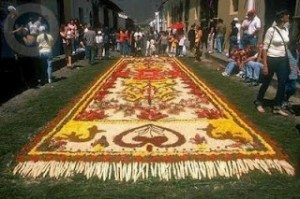
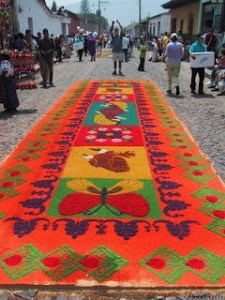
Not MY details…but Expat Mom’s details. She has two great blog posts about Easter in Guatemala with pictures and a great explanation about the order of the procession.
21 Thursday Apr 2011