Fashion Sense

I think I finally found it: I feel like I finally found a “style” that I’m comfortable with, and that is more “me” that most of the stuff I’ve been wearing in my 27 (almost 28!) years of life.
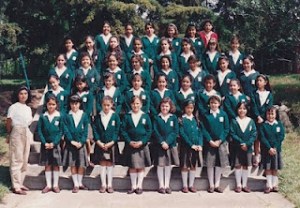
In elementary school my fashion was decided by Catholic nuns and my grandmother, and I rarely complained about what I was told to wear or really cared to give much input. Then I came back to California in the middle of junior high, and my insecurities flourished like no other. I had basically skipped a grade in my transition from the Guatemalan school year to the U.S. school year, so I was insecure about almost everything.
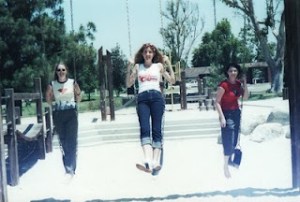
Most importantly, I had missed out on prime years of pop culture (which I’ve never recovered from). There there was the fact that I had attended an all girls school, so dirty jokes that flourish in junior high went right over my head. And the topper: I frequently pronounced things wrong–if I actually looked Hispanic, I’m sure kids and teachers would have understood…but how does a white girl in seventh grade not know how to pronounce basic English words? And why would she ask what her “note” was instead of her “grade”? Well that’s because in Spanish grades are called “notas,” and I decided to go for the direct translation on that one…yep, I can still remember exactly how embarrassed I was when the teacher called me out on that one…in front of everyone. Oh junior high…how I don’t miss you. High school fashion wasn’t much better…as you can tell from the picture below.
Needless to say, I wasn’t the most secure or confident child. High school and college went by, and I never had the guts to wear stuff I really liked, because I didn’t think I could “pull it off.” I still don’t, actually. But one thing that has helped a lot is having a very loving husband who has helped me be more secure about who I am and how I look. He tells me that I can pull things off…so I wear them and realize no one is staring me down as I assumed they would (“what was she thinking when she put that on?”).
So here I am, at the age of 27, and I finally feel comfortable wearing what I want.

February 4, 2011

What I did:

  • Drove to Riverside to meet with my asylum client so we could review and sign the documents we’re filing on Tuesday
  • Stopped by the bank to make some deposits
  • Mailed out Articles of Incorporation for Haiti Scholarships
  • Finally got Board of Directors’ bios and pics up on our website
  • Conference call with silent auction committee for OCHBA
  • Spoke with pro bono coordinator for KIND regarding my motion and my appearance for Tuesday….feeling a little better about it, although knowing me I’ll still have all sorts of stomach queasiness
  • Spent a great evening with Jeff, since he’s been home from work this week and I haven’t had time to enjoy him being home! Went for a nice drive and stroll around Balboa/Newport
  • Applied to three jobs
What I didn’t do:
  • No gym today
  • No small claims
  • No follow ups
  • I didn’t update scholarship applicant profiles; and I haven’t reached out to people regarding sponsors for HS
  • I didn’t work on my u visa petition, which I need to get together by Tuesday also
  • I need to start working on our California state exemption paperwork for HS, so we can get our federal exemption soon

February 3, 2011

What I did:

  • Worked a little more on my motion, worked on supporting declarations and filled out the actual asylum application; spoke with my client and set up an appointment to meet with him tomorrow
  • Went to Annie’s house to meet Lilo and took her on a nice long walk so she could get to know me (I will be walking Lilo a few times a week for the next month and some change in exchange for a generous donation towards my Haiti trip–thank you Annie and Dan!)
  • Went into the office for a little orientation on what I need to start doing next week
  • Made changes to Articles of Inc for HS so I can put them in the mail tomorrow
  • Did our final interview for media intern for HS, made a decision with Jim, and sent an email to the board with general updates
  • Sent an email to my small claims friend with an update on why I haven’t had time to actually do anything on her case…yet. But at least I’m keeping her in the loop!
I had high hopes for this evening, but due to unforeseen circumstances, didn’t quite have the energy or desire to work late tonight. bleh.
What I didn’t do:
  • I didn’t go to the gym, but Annie and I did walk Lilo for almost an hour…that should count, right?
  • Didn’t work on Jim’s research, although I think I’m almost done with it and should be able to wrap it up tomorrow
  • Didn’t apply to the jobs I wanted to apply to today, due to unforeseen circumstances
  • Didn’t look for new jobs to apply to
  • I didn’t work on HS website
A giant thank you to my husband who kept me sane today.

February 2, 2011

Today was one of those days were I worked really hard at ONE thing, so my list is not exactly what I’d like it to be. Oh well…

What I did:
  • Worked on my immigration motion for Tuesday. Got a good rough draft, gonna wake up early tomorrow morning to review and reviese, and fill out the Asylum Application and write necessary declaration to accompany it (I guess this goes in the “to do” column but I’m too tired to cut and past…but not too tired to keep typing…)
  • Made appointment for asylum immigration client
  • Worked out at home
  • Made breakfast for Jeff and I (french toast and bacon, in case you’re curious)
  • Random emails for HS and HBA, but nothing too crazy
  • Looked online for jobs, didn’t find anything too exciting today
  • Worked on research for Jim
What I didn’t do:
  • So many things, and I’m ready for bed…but you know, the usual stuff…
What I have to do tomorrow:
  • I get to meet Lilo tomorrow!
  • See grandma and take her for any last minute errands
  • Possibly one last media intern interview with Jim
  • Finish the stuff I mentioned above
  • Stop by Maggie’s office so I can figure out what I’m doing
All in all, not feeling the most accomplished today, but I do feel good about the progress I made
on the motion. I’m just not used to having one project take up so much time…

February 1, 2011

First of all, I can’t believe February is already here. Where did January go?!

What I did:
  • Cleaned up the kitchen a little
  • Spent some quality time with my grandma, since she’s going back to Guatemala on Saturday :(
  • Printed and reviewed a bunch of asylum documents so I can start preparing my motion for next week. Starting to get nervous about this.
  • Met with my U-visa client, reviewed declaration and petition, set a follow up appointment for next week so we can start wrapping things up
  • Spoke with Maggie about working at her office part time
  • Interviewed another potential media intern with Jim
  • Prepared our state and federal taxes….all ready in an envelope and ready to get our refund!
  • I looked for jobs
  • Started working on research for Jim
What I didn’t do:
  • I didn’t go to the gym
  • I didn’t apply to any jobs
  • I didn’t get started on my small claims case
  • I didn’t do as much as I wanted on my asylum case
  • I didn’t work on HS website
Not the greatest day as far as accomplishments go…which will make tomorrow a busy day.
What I need to do:
  • Work on Jim’s research project
  • Need to set up an appointment for this week with asylum client so he can review and sign documents, and we can prep for next week’s hearing
  • All of the above items

January 31, 2011

What I did:

  • I WENT TO THE GYM!! And here you were, thinking it would never happen…
  • Sat in, or heard in, on a couple interviews with Jim for a media intern for Haiti Scholarships
  • Met with an old boss regarding possible temporary work at his firm
  • Went to CoffeeBean and got some work done on my U visa petition, including working on declarations, table of contents, and filling out the I-918
  • Finally wrote out a blog I’ve been wanting to write for a while with snippets from various books I’ve been reading
  • Wrote cover letter to send fundraising check to All Hands from the Oggi’s fundraiser earlier this month
  • Tried to crunch some numbers, with negative results
  • Did some work on OCHBA dinner committee
  • Started editing bio’s from HS board of directors
What I didn’t do:
  • Fill out asylum claim
  • Work on small claims
  • Upload bio’s for Haiti Scholarships, try to find more donors
What I need to do:
  • Look for my photography contract so I can review the terms
  • Follow up again on OCHBA silent auction donations and sponsorships

What I’ve Been Reading Lately…

Over a year ago, I wrote about reading series of books, and how it had become a bit of an obsession of mine. Lately I haven’t been reading any series of books, per se, but have definitely fallen into a very particular genre of books. For Christmas, Jeff and I each got a $25 gift card to Barnes & Noble from his parents. Let me tell you, we are both huge fans of reading, so we were pretty stoked about this gift, and didn’t wait more than a day to hit up B&N and find something exciting to spend our money on.

Jeff mentioned I should spend my money on getting something “fun” to read this time, since every book I’d read before then was pretty serious in nature. I tried. But I just couldn’t. I went to the Spanish section, where I usual find a good, light-hearted and entertaining read (and I get to brush up on my Spanish). There were several titles that looked intriguing, but not nearly enough so to make me want to spend my Christmas gift on them. I was itching to head back downstairs to the section that really interested me. And so it was that my gift card was used for the same type of “serial” reading that I’ve been doing lately. I feel the books I’m choosing lately are almost a self-education in a new area of study: I can’t afford to pay for a masters in international development, but I’m reading a lot of literature about it, and maybe that’s enough for now.
So here’s my list of serial reading in international development/non-profit development so far:
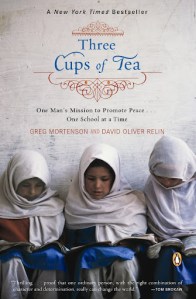
It all really started with an ad in the online version of the New York Times for Three Cups of Tea. Jeff will tell you I’m a sucker for advertising. The reviews were great, I bought it, I read it. My initial reaction is to say that it was great, inspiring, moving, entertaining, etc. And I think it was (it’s been a while), but I do believe it took me a while to actually get into it. If you haven’t heard about this book before, it’s the story of how Greg Mortenson started the Central Asia Institute, a non-profit that raises money to build schools in Afghanistan, and now Pakistan. It really is an inspiration of how much one man can accomplish, and a testimony to what a difference education can make.

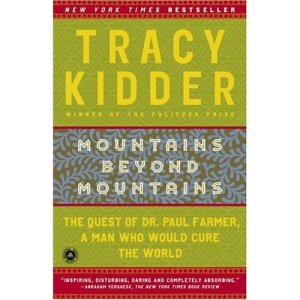
The first book I bought after I returned from my trip to Haiti was Mountains Beyond Mountains, by Tracy Kidder. It tells the story of Doctor Paul Farmer, who I’ve already mentioned several times in Cielo Azul. With this book I started to fold the top corner of passages or quotes that I liked, or stuff I wanted to research more (but still haven’t). Here are a few:
  • “‘Clean water and health care and school and food and tin roofs and cement floors, all of these things should constitute a set of basics that people must have as birthrights,'” quoting Dr. Paul Farmer, page 91.
  • Page 116 describes Dr. PF’s writing of The Uses of Haiti, which I want to eventually read.
  • “There are more billionaires today than ever before…We are talking about wealth that we’ve never seen before. And the only time that I hear talk of shrinking resources among people like us, among academics, is when we talk about things that have to do with poor people…Margaret Mead once said, Never underestimate the ability of a small group of committed individuals to change the world…Indeed, they are the only ones who ever have.” Quoting Jim Kim, page 164.
  • “Change the world? Of course they could. [Paul Farmer] really believed this, and he really believed that ‘a small group of committed individuals’ could do it. He liked to say of PIH, ‘People think we’re unrealistic. They don’t know we’re crazy.'” Page 169.
  • “If one pushes this ology to its logical conclusion, then God is to be found in the struggle against injustice. But if the odds are so preposterously stacked against the poor–machetes versus Uzis, donkeys versus tanks, stones versus missiles, or even typhoid versus cancer–then is it responsible, is ti wise, to push the poor to claim what is theirs by right? What happens when the destitute in Guatemala, El Salvador, Haiti, wherever, are moved by a rereading of the Gospels to stand up for what is theirs, to reclaim what was theirs and was taken away, to ask only that they enjoy decent poverty rather than the misery we see here every day in Haiti? We know the answer to that question, because we are digging up their bodies in Guatemala.” Paul Farmer discussing his distrust of ideologies, page 195.

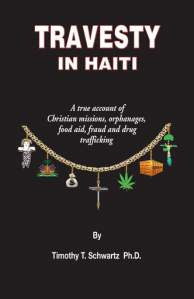
Next came Travesty in Haiti: A true account of Christian missions, orphanages, fraud, food aid and drug trafficking, by Timothy T. Schwartz. This book gives a critical look at how foreign aid has really affected Haiti. I think it’s a great read for anyone wanting to work in this field, so you know what you’re dealing with, and what you want to avoid. He spoke a lot about the effects of food aid, and large NGO’s that work in Haiti. With this book, I moved it a step up from folding pages to….highlighting!
  • “I came to understand that food aid crashed the local agriculture markets, driving peasants off the land…” (page 47).
  • Speaking about what little there was to know about wind generators that had been installed in the early 1990s, and quickly fallen into disrepair: “But it was enough because it is the typical story regarding development all over Haiti: ‘It is broken, can’t be fixed, and nobody knows anything else about it.'” (page 66)
  • “When I first arrived in Haiti…I was enthusiastic. My enthusiasm and belief that I could make a contribution kept me returning despite the hardships, the violence, the coups, and the embargoes. But ten years later I was a different person. Perhaps I was simply burned out…Perhaps more than anything else, by 2000, I no longer was an objective researcher. I was deeply angry at what I perceived to be the widespread fraud, corruption, arrogance, greed, self-interest and apathy that afflicted the entire development community which was, in my opinion, a total failure, serving only to make the poor poorer and the rich richer” (page 216).

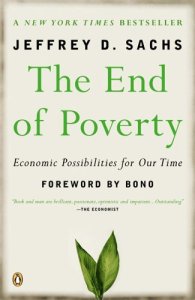
Then, per a friendly recommendation, I read The End of Poverty, by Jeffrey Sachs. This book was a little challenging for me, since it’s heavy on economics and numbers. Let’s just say that in college I took the “economics for dummies” course. It had a lot of interesting information and thoughts on how poverty can actually be eradicated in time to meet the Millennium Goals. Curiously enough, the book I’m currently reading, The White Man’s Burden, is a response to some of Mr. Sach’s arguments. One of my favorite parts of the book was actually the forward by Bono.
  • “More than one million African children, and perhaps as many as three million, succumb to malaria each year…There is simply no conceivable excuse for this disease to be taking millions of lives each year” (7).
  • “The rich countries do not have to invest enough in the poorest countries to make them rich; they need to invest enough so that these countries can get their foot on the ladder [of development]” (73).
  • “Eliminating poverty at the global scale is a global responsibility that will have global benefits. No single country can do it on its own” (327).
  • “American political leaders and the broad public rarely recognize that the U.S. government has repeatedly made international commitments to do much more than the United States is doing, and even less do they realize that the lack of follow-through carries an enormous foreign policy cost” (337).
  • On page 350 Sachs discusses the importance of education: “The wider the education, including in social and political principles, the more peaceful, sound, and progressive the entire society would be.”

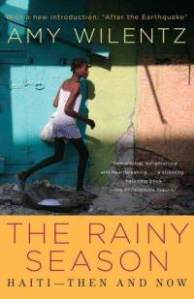
After scanning a few stands at Barnes and Noble, I came across The Rainy Season by Amy Wilentz. What I loved about this book is that it was an interesting way to learn about the historical context of Haiti, including the end of the Duvalier regime, and the rise of Aristide.
  • “Haiti’s stuck in an uncomfortable position now: the earthquake has opened the country up to all sorts of interventions, speculations, and exploitations, but unquestionably the help is needed. There’s very little room for resistance in this disaster. The country’s lying there like a rape victim waiting for further onslaught” (introduction, xiii).
  • “It took me a little while to realize that if you wait long enough in Haiti, and really not so long, the tyranny and violence is likely to return, and that a people’s victory is not always in the end what is seems to be in the beginning” (20).
  • “Whenever change is effected without bloodshed in Haiti, it means that an equitable deal has been struck among all interested parties” (129).
  • There is an interesting paragraph about the culture of voodoo and it’s perseverance despite foreign opposition to it; too long to type out now though :) page 165.
  • Page 183 provides great insight to the relationship between poverty and religion.
  • Page 267 talks about trees, and how there are many NGO’s that want to give trees to farmers in order to improve deforestation, but farmers are weary of planting trees because they can’t afford to use what precious water they have on growing trees, trees that are not going to be quick cash returns.
  • Speaking to an AID worker about Haitian’s that don’t support NGO projects because they know these projects fail to follow through on promises made: “‘I know, I know,’ he said. ‘But at a certain point, who cares if they want it? They need it, and they’re going to have it. They don’t understand. What Haiti needs is infrastructure, and we are going to make sure they get it whether they want it or not'” (284).
  • Some of the most sobering passages of Wilentz’s book are graphic descriptions of violence surrounding elections.

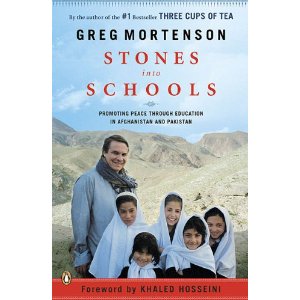
I then went back to the beginning, and decided to read the sequel to Three Cups of Tea: Stones into Schools, by Greg Mortenson. This book follows Mortenson’s quest to start building schools in the most difficult regions of Pakistan. I sadly just realized I didn’t highlight much on this one, but I did find it a much more entertaining read than Three Cups.
  • “Amid the rush to provide tents, food, and medical supplies, few of the western NGOs seemed to be giving much thought to schools. Based on past experience, however, the militant groups who were busy setting up their aid networks fully understood the power of education under such circumstances” (179).
  • Mortension writes about Chritopher Kolenda, and a book written by him called Leadership: The Warrior’s Art. On my follow up list.
  • “…I am told that there will be roughly 200 children who will study at the school; and that the skills they will learn and the ideas to which they will be exposed may usher in changes–some good, others bad–which no one can foresee” (epilogue, 375).

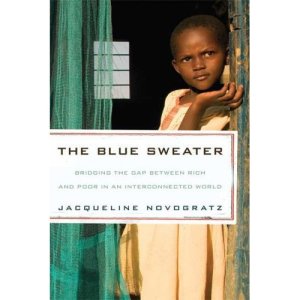
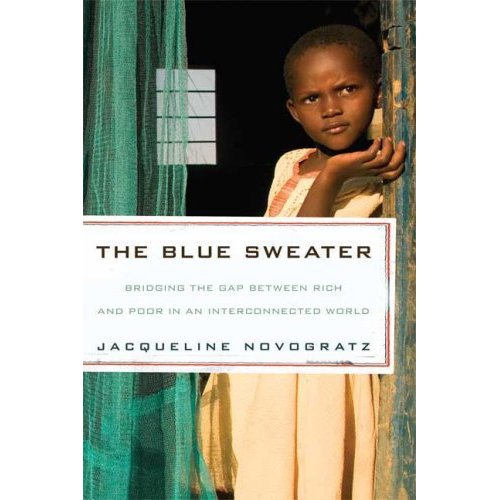
My last read was The Blue Sweater: Bridging the Gap Between Rich and Poor in an Interconnected World, by Jacqueline Novogratz. Novogratz is the founder of Acumen Fund, and talks about how she began developing for-profit enterprises by and for the poorest populations around the world.
  • “I began to see what it meant to put into practice the idea of extending basic services as simple as bank accounts that the middle class took for granted to people who are often invisible to those in power” (17).
  • “Cote d’Ivoire became a place where just walking down the street filled me with questions about justice and compassion, power and money, and the randomness of where we are born and how much that determines who we become” (23).
  • “In this case, well-intentioned people gave poor women something ‘nice’ to do, such as making cookies or crafts, and subsidized the project until there was no more money left, then moved on to a new idea. This is a no-fail way to keep already poor people mired in poverty” (76).
  • “Meanwhile, I found myself frustrated once again by development ‘experts’ who looked in from the outside and suggested clever solutions that created a lot of noise, distorted markets, resulted in systemic corruption, and accomplished little” (94).
  • Somethings to check out: Next Generation Leadership, Three Guineas Fund
  • “Patient capital is money invested over a longer period of time with the acknowledgment that returns might be below market, but with a wide range of management support services to nurture the company to liftoff and beyond” (229).
  • “That same resilience, however, can manifest itself in passivity, fatalism, and a resignation to the difficulties of life that allows injustice and inequity to strengthen, grow, and solidify into a system where people forget to question until an event or series of events awakens the next generation” (275).
  • “They balance their passion for change with an ability to get things done. Mostly, they believe fundamentally in the inherent capacity of every human being to contribute” (277).
  • “…scientists are finding, not surprisingly, that the one factor that does bring greater happiness is serving others..” (279).
All in all, I’m quite enjoying my current series. Feel free to send me any recommendations you think might fit in :)
*PS: this is my 200th blog entry. Can’t believe I’ve been boring you guys with my thoughts 200 times already.

Haiti Stories: Presented at the Fowler Museum, UCLA

“Did you dress up for Paul Farmer?” “Yeah, is that creepy?”

So began Abby and my trip to the UCLA Fowler Museum for their conference: Haiti Stories/Istwa Ayiti. And it only got better. The speakers included some of the most fascinating and inspiring people from all walks of life: poets, writers, journalists, photographers, academics, doctors, human rights activists, anthropologists, film makers, and the list goes on. I was honestly star struck.
Damon Winters, a photojournalist with the New York Times, opened with some amazing pictures from Haiti that brought people to tears. I was truly sad when he ran out of time, since it seemed he had a lot more pictures to share.
Right after Damon, Don Cosentino gave an interesting presentation on Haitian vodoo. He shared some great pictures and stories, but most impressive was something that Abby pointed out as he was getting on stage: his cane was black, with red flames coming up from the bottom. Now here is a man I want to buy a drink for, and just hear story after story…
Next up was anthropologist Catherine Maternowska, co-founder of Lambi Fund of Haiti. Her story brought me to tears. She spoke of a baby who had oral and anal gonorrhea after a man cut through her tent, tied up her pregnant mother, and orally and anally raped her. But she also spoke of the compassionate US military personnel who helped her obtain much needed supplies to provide care for these victimes by reporting the materials “lost in transit, unaccounted for.” It’s insane that she had to rely on conspiring humanists to provide basic materials, since the release of aid materials was/is surrounded by red tape and basically bullshit. But at least she found someone who was willing to look the other way.
Then there was the LA Times writer, Joe Mozingo, who spoke of the increasing responsibility of the media to portray Haiti in its entirety, not only the ghastly stories that create headlines because they’re horrific and shocking to us. He called for a focus on the bigger picture, not just the horror of Haiti. I loved his honesty and clarity.
Here’s a cool piece another presenter, Maggie Steber, worked on, which are photographs of a whole boulevard in Haiti, kinda cool.
David Belle gave a presentation about the only film school in Haiti, located in Jacmel, which allows Haitian students to learn how to make films and commercials. They just received a contract worth millions of dollars to make commercials for an energy drink in Haiti! He showed several clips of the work Haitian students have done, most impressively a documentary that was presented at the Amsterdam Film Festival. You can check out the trailer here. Please check it out. I’m going to do some research to find out where the whole movie is available…
Claudine Michel is a professor of black studies at UCSB, and she used an interesting phrase in her presentation: “how many cups of revolution…” She used this phrase repeatedly, as in: how many cups of revolution until the little girl in the camps doesn’t have to wear a whistle to prevent her from being raped when she goes to the restroom at night? How many cups of revolution until….etc. I might have heard wrong, because I don’t know exactly what “cups of revolution” means, maybe someone can enlighten me, but I liked it nonetheless.
I wish Paul Farmer had talked more, but he did have some good thoughts about foreign assistance; basically: good intentions go astray. He mentioned how much rhetoric has been centered around building Haiti “better,” and he said we need to build back foreign assistance better also, because there are so many flaws in how it’s done. “Good intentions are not enough, actions are what matter.” Personal hero.
Bob Maguire, a professor of international affairs and director of the Trinity Haiti program, also had a good quote: “development is not a matter of changing things, but changing people.” I think I could write my thoughts about that for a while, but I’m growing sleepy and I’m sure readers are growing weary…
Amy Wilentz, the moderator for the event and author of The Rainy Season, mentioned she was reading a book by Erica James. I believe I have found it on Amazon, and it will probably be my next read once I finish The White Man’s Burden, which is proving to be a slow read for me.
This is basically a regurgitation of my notes from the event of stuff I wanted to check out or follow up on; hopefully they’re helpful to someone other than just myself.
On a semi-sidenote: when people are given the privilege to address amazing individuals at a conference during the q&a session, they need to save everyone’s time and just ask the question so the panel will have the time to fully discuss and answer it, rather than spend five minutes trying to impress the panel with what they’ve done with their lives and who they are. I’m sorry, but it’s true :)
January 29, 2011

What I did:

  • Attended an AMAZING presentation at the Fowler Museum with Abby and Christina; took up most of my day
  • Applied to a job this morning, although I’m not quite qualified for it…you never know though
  • Got some important documents from my asylum client, have to get to work on his petition
  • Sent Karin an email with my silent auction updates
  • I’m planning on looking for some more job leads tonight, fingers crossed
  • Emails and skpe with the HS crew
What I didn’t do:
  • Go to the gym (duh)
  • Any of the other stuff that I’m already days behind on
Design a site like this with WordPress.com
Get started